Thursday, September 27, 2012

By The Numbers


The 8th U.S. Cellular World Food Festival "By The Numbers"

Number of planning meetings before the festival: 3
Number of hours spent making the map: 6
Number of food vendors: 39
Number of food plates drawn by children: 100+
Number of banana costumes: 1
Number of bruised thumbs: 2 (low accuracy with a hammer)
Number of days in the East Village: 3
Number of attendees: 75,000 (approximate)
Number of recorded volunteer hours: 150
Number of minutes on the DVD tribute slideshow: 25

And…drum roll, please…


Number of petition signatures: 1,050


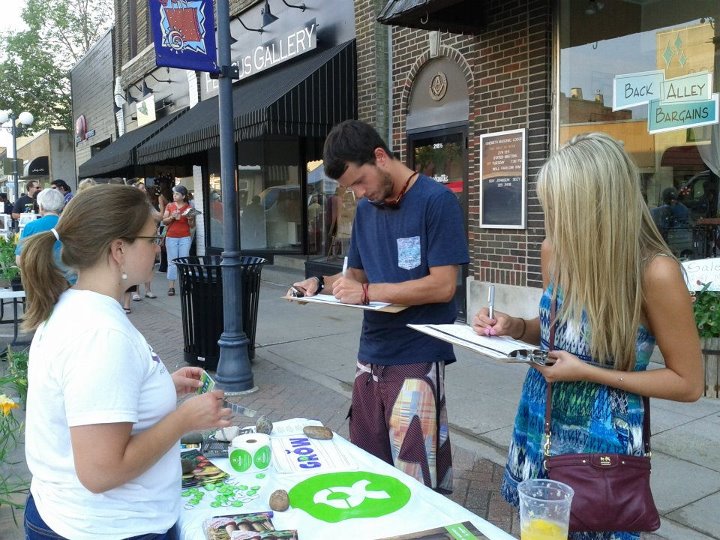
We really couldn’t be more impressed with how receptive festival-goers were with Oxfam’s GROW campaign. Check out the pictures below (and more on our Facebook page) for how beautiful our booth looked with all of the plates of food that children were drawing. So many thanks to our volunteers and to everyone who stopped when we said, “Have you heard of Oxfam?”

 
Children were asked to make plates of food
for a child that didn't have enough to eat.

Volunteers Brittney and Aaron showcase
our Oxfam booth!

Stay tuned for our Des Moines GROW Method Binder, which will be uploaded with next week’s blog post. After that, we start a 3-part series of blog posts leading up to the World Food Prize here in Des Moines and a celebration of World Food Day.

Wednesday, September 19, 2012

Sneak Peek...

While your Iowa Oxfam Action Corps has been busy these last two weeks with farmers markets (tabling and outreach) and harvesting at a local community garden, we've also been preparing for this weekend's U.S. Cellular World Food Festival in the Historic East Village of Downtown Des Moines.

We're excited to share the GROW Method with festival-goers and we wanted to give everyone a little "taste" of what's coming to a food festival near you.


Yes, that is a map of the East Village (though objects in camera are larger than they appear) and yes, that is a man wearing a banana costume. Get excited Des Moines! Stay tuned to our Facebook page for details about our exact booth location.

Saturday, September 8, 2012

"Earth's Best Defense" presents on Wasted!

It shouldn't come as a huge surprise. You wander into the kitchen, open the refrigerator door, and there they are: moldy strawberries, wilting lettuce, and an array of weeks-old leftovers that you either forgot about or were too busy to eat. "Oh yeah! I WAS going to eat that..."

Let's face the ugly truth: As Americans, we're quite wasteful. A new report from the Natural Resources Defense Council (Motto: "The Earth's Best Defense") puts a stunning number on the wastefulness, too...40%. But they don't stop there. Their report examines every stage from Farm to Fork to Landfill and all those steps in between to provide a truly comprehensive look at where the inefficiencies exist in our food system that result in such a mind-blowing number.

The average American household throws 
out 20 pounds of food per person per month!
Now, you might think that mega-farms or corporations are to blame for the majority of the 40%. Yes, they are responsible for a share of it...but it's actually us - the individuals and families making food purchases who contribute the largest share of food waste. Yuk!  In fact, if 15% of the food waste was recovered and put on the table for hungry families, we could feed 25 million people! That makes a huge difference considering here in the U.S., 1 in 6 people are food insecure.

So, it only makes sense that Oxfam's GROW Method is the next logical step in the process. One of the key components is reducing food waste so that we, as individuals, can make a difference. Between the Pinterest page and Facebook app, you can learn (and contribute!) new ways of thinking about your food and how to lower your "foodprint".

For a one-pager version of the NRDC report highlights, click here.

For the complete NRDC 25+ page report "Wasted", click here.

Thursday, August 30, 2012

Ding! Ding! And the Annual Hunger Fight begins...

While not affiliated with Oxfam America, we can’t pass up the opportunity to share what another local organization is doing to fight global hunger. Meals from the Heartland (started in 2008), utilizes large groups of volunteers to package rice, TVP, dehydrated veggies, and vitamins together to help feed starving people around the world. Starting yesterday (8/29), MFTH began their Annual Hunger Fight, a push to package 5 million meals which provides 30 million servings. 15,000 volunteers comprised of mostly Iocal Iowans work 2-hour shifts assembling the ingredients at Hy-Vee Hall in Des Moines, Iowa (what MFTH calls “The Hunger Fighting Capital of the World”).

The first day of the 2012 Annual Hunger Fight saw nearly 1.3 million meals packaged. While 5 million meals will not deliver a T.K.O. to global hunger, it does show that at least 15,000 people here in Iowa don’t think its right that 1 billion people go to bed hungry every night. That’s where Oxfam America steps in – to create those lasting solutions to poverty, so that a day may come when we can, together, deliver a massive blow to global hunger and the work of organizations like MFTH is needed far less.

Check out a local media video clip here about this year’s Annual Hunger Fight. Oh, and you might want a tissue…


A young girl scoops up dehydrated veggies. No
matter your age- you, too, can fight global hunger!
 

Thursday, August 23, 2012

Going for Gold!


On August 12th, millions all over the globe watched the star-studded closing ceremonies of the 2012 Summer Olympic Games in London. During the preceding weeks, we watched as over 10,000 of the world’s best athletes gave their all for a shot at gold medal glory. It was a spectacular Olympic Games – even West Des Moines, IA resident Gabby Douglas wowed us and brought home some Olympic Gold. Go Gabby! The spirit of the Games is that these athletes can showcase their potential – their prowess. 

Also on August 12th (in front of 10 Downing Street), Prime Minister David Cameron and Vice President Michel Temer of Brazil (host country for the next Summer Olympics) challenged global leaders to step up efforts to improve nutrition and reduce the rate of stunting among the world’s poorest children before the next Summer Olympics in 2016. That is, help the world’s poorest children realize and achieve their potential – building on the movement started at the G8 Summit.

The Global Hunger Event will help to strengthen these commitments by identifying pioneering new ways of working to tackle malnutrition and bringing in new champions to support the global food movement. Among its supporters is Olympic Gold Medalist Mo Farah, dubbed “the world’s fastest man” who is featured in the quick video below. There is also another unlisted video here.


Friday, August 17, 2012

When drought happens...


Here in the United States, it’s the worst one in 56 years. The USDA is forecasting a drop in corn and soybean yields somewhere in the 10-15% range by the time harvesting starts next month. All-the-while, Capitol Hill current debates waiving a requirement that would allow for the U.S. to lower its use and production of ethanol in order to let more of the corn be used for food and livestock feed. Most Americans see the dead grass on their front lawns, read news articles about how to conserve water, and will probably see a rise in food prices throughout the fall and winter when they go to the grocery store because it will cost a little more to truck in food from other areas of the country. As food prices rise, there will be more applications for SNAP, more walk-in’s at food pantries, and more people forfeiting nutrition in order to simply afford their next meal.

Half a world away, in Burkina Faso, Africa, they’re having a drought too. But, it’s the third major drought in recent years. The U.N. World Food Programme estimates they’ve lost 50% of their grain crops (and a majority of livestock) this year alone, leaving 1.7 million people (11% of their population) at risk for starvation. Tragically, the food that is making it to market is highly priced – much more so than an average family can afford on an average per capita income of 300 U.S. dollars. Even worse, Burkina Faso’s economy is so shaky (mostly built on agriculture) they don’t have much to export and ultimately trade for food. The U.N. is providing most of the emergency food/water assistance but it won’t reach everyone. The situation is deteriorating near the Mali border where thousands of hungry, conflict-weary Malians have crossed the border and poured into refugee camps being administered by the Red Cross. No rains are forecasted and the lean season is fast approaching.

Villagers in Tin Akoff, Burkina Faso collect water

Think about this: when drought happens in the U.S., the media talks about crops lost. When drought happens in places like Burkina Faso, they talk about people lost. As if somehow the two are equal…it’s a injustice and we know it doesn’t need to be like that! That’s why organizations like Oxfam America are deployed in the Sahel, bringing lasting solutions to the inequities that result in extreme poverty. We know that this isn’t Burkina Faso’s last drought and if we can provide them the tools and resilience to respond to this one and any future drought, we’ve made the world a more secure place. That’s how we make our home a better home for all.

Help us take action – sign a pledge, start a fundraising page, follow or ‘like’ Oxfam on the social media outlets! Act Fast!

http://actfast.oxfamamerica.org/index.php/issues/hunger

Sunday, August 5, 2012

Farmer's Market: Take #2


Have you heard?! Since 2000, when the United States Department of Agriculture (USDA) first proclaimed National Farmers Market Week, the number of farmers markets in the United States has grown 150%, from 2,863 in 2000 to 7,175 in 2011.

That’s a fun little fact, isn’t it?! So, why the increase? Well, that’s probably a better question for each individual farmers market attendee. Maybe they like to support their local farmers through rural renewal, engage through civic duty, promote food equity, or maybe they just really enjoy the yummy foods. Point is: farmers markets are economic "engines" and people can’t seem to get enough of them (at least that’s what I read when I saw that first statistic).

In developing countries, markets are often the sole livelihood of many farmers. And there are so many reasons why a farmer wouldn’t be able to get her crops to the market. Take your pick of washed out roads, droughts, diseased crops, etc. So, we wanna talk solutions. Rights-based solutions. How do we empower the farmer? How do we “lift” a community from poverty by giving them the power to self-sustain? And taking it one step further…how can we (here at home) help?

That’s the conversation we want to have with you. It’s a conversation because we want to hear your ideas. Back in June, we heard from attendees at the Southridge Des Moines Farmers Market. This last Thursday (8/2), we heard from market "go-ers” at the Historic Valley Junction Farmers Market in West Des Moines. 80 people signed our GROW pledge. That's 80 more people who are ready for a world without hunger - to be agents for change, "engines" for justice. We hear you telling us to set the table - our human family of 9 billion is on the way.

Amy shares Oxfam's message: 
Let's feed a world of 9 billion.

"Laying it out" for a market attendee.

Local musicians for the "Music 
in the Junction" series.